When clients call Fraser Construction about building a commercial metal structure, many believe it’s as simple as ordering a building and getting started. The appeal of quick and cost-effective construction often overshadows the complexities involved in bringing these projects to life. But here’s the reality: while you might install a residential “man cave,” “Barn-dominium,” or “she shed” in a matter of weeks, commercial metal buildings involve a labyrinth of permitting, technical reviews, and environmental considerations.
Every detail—down to the building’s use and its environmental impact—must align with rigorous site development standards in the Lowcountry. In this guide, we’ll demystify the process, showing you why preparation and expertise are essential to turning your vision into reality.
Why is there a site development process?
First, why do people love the Lowcountry? It is undoubtedly tied to our natural resources, especially our saltwater estuaries and outdoor living. Site development processes were put in place decades ago and are constantly evolving to mitigate site development’s impact on our natural resources, traffic grid, and the community at large. Development adds impervious surfaces, increasing stormwater runoff, which can destroy ecosystems without proper runoff retention and treatment measures.
Our local waters, especially the May River, are unique in that they support the last remaining hand-shucking oyster house in South Carolina. Oysters, as powerful filter feeders capable of cleaning up to 50 gallons of water daily, are highly sensitive to water quality changes and contaminants from runoff, making them excellent bioindicators of ecosystem health while also being vulnerable to environmental degradation caused by urban and agricultural development. Beaufort County and its municipalities have stringent site development processes with a heavy focus on stormwater regulations to protect its delicate ecosystems and prevent the downstream impacts of urban development.
What is the site permitting process?
Our local jurisdictions’ site development processes have at least five steps before submitting for a building permit. Larger or special circumstance projects may involve additional steps depending on the jurisdiction. For the Town of Bluffton, Town of Hilton Head, and Beaufort County, these steps include:
- Pre-Application Meeting: Applicants meet with town staff and other relevant agencies to discuss the proposed project, its feasibility, and applicable standards. On Hilton Head, a project manager is assigned to the project after this step.
- Application Submission: The applicant submits a complete application form, required fees, and all necessary documentation. The Growth Management Customer Service Center manages this process for Bluffton. Hilton Head applicants may submit under categories like Minor Development Plan, Major Development Plan, or Small Residential Review.
- Staff Review: Town staff, including the Bluffton Development Review Committee (DRC) and Hilton Head LMO staff, conduct an administrative review of the application.
- Technical Review: Each jurisdiction conducts detailed technical reviews involving different committees. In Bluffton, the Development Review Committee (DRC) reviews the project, followed by the Historic Preservation Review Committee (HPRC) and sometimes the Planning Commission. On Hilton Head, the Architectural Review Board (ARB) handles design-specific reviews. Beaufort County uses the Design Review Board (DRB) for a similar purpose.
These reviews are often split into conceptual and final approval phases. Between these phases, stormwater departments review and approve plans, including those under the South Carolina Department of Environmental Services (SCDES) for Coastal Zone Consistency (CZC). Each committee provides feedback that applicants must address before moving forward. - Town/County Council Approval: Some applications require final approval from the County or Town Council, which considers technical reviews, Planning Commission recommendations, public comments, and compliance with regulations.
- Revisions and Resubmittals: If necessary, the applicant makes revisions based on staff and committee feedback and resubmits plans.
- Permitting: Upon approval, the applicant can proceed with obtaining necessary permits for construction.
What limitations do site development processes and stormwater programs have on the building?
In each jurisdiction’s land use ordinances, there is a balancing act between parking and stormwater design requirements. On one hand, a building mandates a minimum number of onsite parking spaces, including wheelchair-accessible spots. On the other hand, the roof of the building, combined with the parking lot, contributes to increased impervious surfaces.
Stormwater Design Manuals (SWDM) and NPDES Phase II Stormwater Programs require that the site mitigate both the increased volume and reduced quality of stormwater runoff. To address the increased runoff volume, onsite stormwater retention ponds are often utilized. However, these ponds must fit within the parcel boundaries, cannot be located in wetlands or setback buffers around the perimeter, and can only be so deep before reaching the Lowcountry water table. Additionally, although ponds can help mitigate the stormwater volume control, the local regulations don’t allow wet-detention practices to count towards the water quality requirements.
Regarding the client’s request for a pre-engineered metal building for commercial use on a tight timeline, they need to keep in mind that after accounting for wetlands, setbacks, parking, and stormwater requirements, the available building space becomes quite limited.
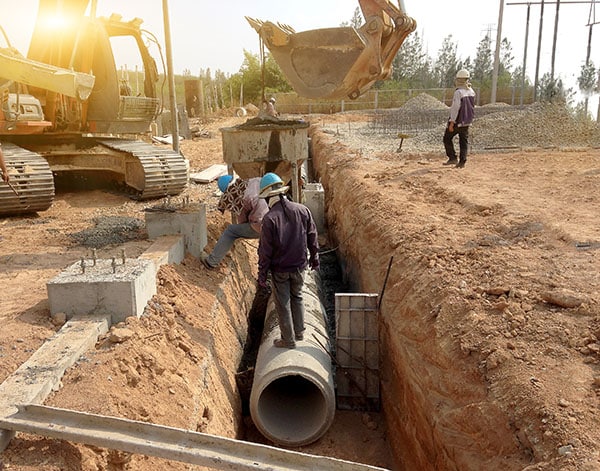
When site constraints force the building to shrink beyond the client’s initial plans, civil engineers can get creative with the design. For example, instead of using traditional onsite stormwater ponds, engineers might suggest using perforated stormwater pipes, which are placed in pervious rock, or underground stormwater chambers. But this is dependent on the underlying groundwater table and soil characteristics. The parking lot can also be designed with pervious paving (permeable pavers, pervious concrete, aggregate with geo-web, etc.) for vehicles instead of regular asphalt, which won’t count toward the impervious area total, but can be more expensive. Although these measures count towards water quality, additional measures are often still needed.
For this, infiltration basins, bioswales—small, shallow areas with vegetation—can be used. They take up less space than a full retention pond but still provide effective filtration.
How long does the site permitting process take to approve?
It takes a significant amount of time—longer than the design and fabrication of a metal building. Site permitting is typically the critical path of a project and cannot be accelerated by prematurely placing an order for the metal building. Each approval process requires several weeks to get on a committee agenda, conduct the meeting, address comments, and move to the next step. One particularly lengthy step is obtaining approval from the South Carolina Department of Environmental Services for Coastal Zone Consistency (CZC), which can take 6–8 months. After the CZC application completes its 10-day notice period, it enters a long queue, processed by only three individuals handling the entire coastal region.
What is the best approach to streamlining the development process?
The key to streamlining development is timing the order of the metal building during the design phase, specifically after completing the CZC process. Currently, we manage pre-construction around the CZC process and stormwater design. Since most technical reviews involve both preliminary and final steps, we pause the building design at the schematic level until the preliminary site work is completed.
Conclusion
Effective stormwater management is essential for the success of metal building projects in Beaufort County. By understanding local regulations and addressing the challenges posed by the area’s unique environment, Fraser Construction ensures its projects meet all requirements while protecting the county’s delicate coastal ecosystems. Our collaboration with civil engineers and design-build solutions provides clients with a seamless, sustainable approach to building in this beautiful region.
If you’re ready to start your next project with a partner who understands the complexities of local regulations and sustainable design, contact Fraser Construction today to discuss how we can help bring your vision to life.